
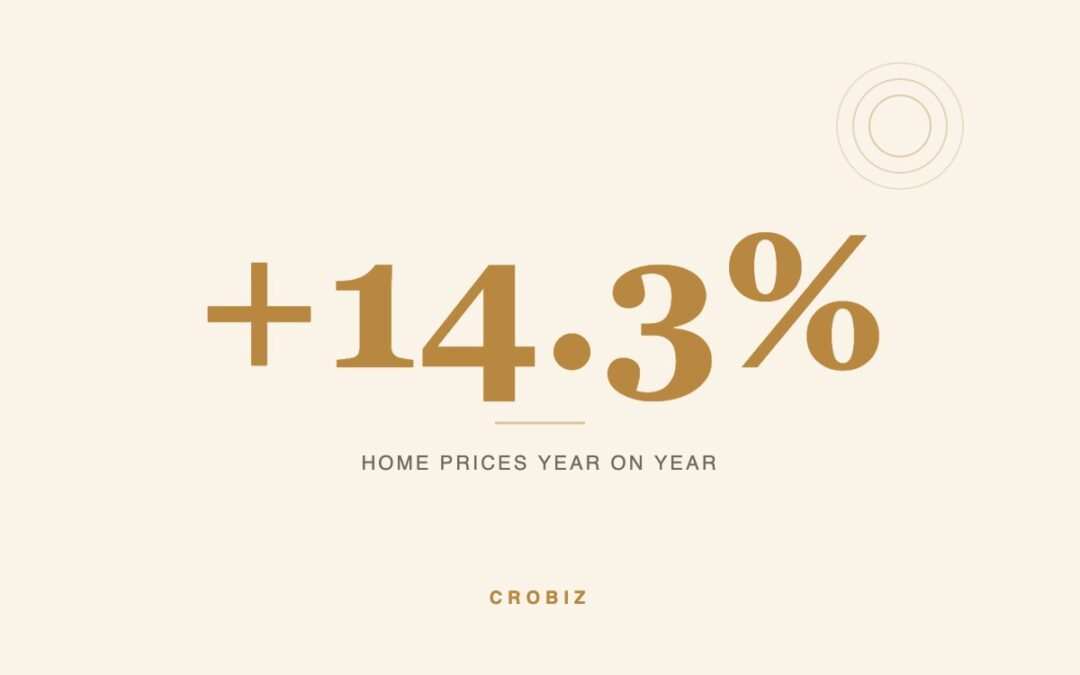
The Croatian property market in 2026 presents a striking paradox. Home prices are rising faster than almost anywhere in the EU, yet the number of transactions has collapsed. Construction permits are falling, yet construction turnover keeps growing. Here is what is really happening, and where the opportunities lie.
Property prices: +14.3%, but transactions −42.2%
Comparing the first quarter of 2026 with the same period of 2025:
- home prices rose 14.3% year on year, roughly three times faster than the EU average of 5.1%;
- the number of apartments sold fell by 42.2%;
- prices have risen 41.4% over the past four years;
- the IMF estimates a shortage of around 232,750 homes.
Average 2025 prices in the five largest cities were over €4,000 per m² in Split, around €3,000 in Zagreb and Zadar, about €2,800 in Rijeka and roughly €1,500 in Osijek.
What the market is really saying
- Croatia ranks fourth in the EU for price growth, behind only Portugal (+17.8%), Bulgaria (+14.8%) and Slovakia (+14.4%).
- Offers are there, but buyers are waiting or dropping out. Transaction volume fell 42% and turnover value 35%.
- Split symbolises the new reality. An average annual net salary buys just 4.5 m² of apartment there, around 6 m² in Zagreb and Zadar, and about 11 m² in Osijek. Coastal prices are no longer tied to local purchasing power, but to tourist and foreign demand.
- The structural shortage will support prices for years, regardless of the current slowdown in transactions.
The conclusion: the market is not entering a decline. It is entering a mature phase of the cycle, in which prices grow more slowly but hold, and buyers become more selective. Buying anything because everything gets more expensive no longer works.
Sources: Forbes Hrvatska (Zaba and Arhivanalitika), Glas Slavonije, Kvadrat.hr
Construction: permits −14.3%, turnover +2.9%
In the first half of 2026, Croatia issued 5,083 building permits, 14.3% fewer than a year earlier, yet construction turnover still grew 2.9% in the first four months. The permits issued cover works worth around €3.3 billion; construction accounts for about 7% of GDP and employs around 27,000 foreign workers.
- Fewer projects, but bigger ones. The average permit in July 2026 was worth around €545,000, as developers focus on large, multi-phase schemes.
- Labour shortages are the sector’s biggest problem. Around 27,000 foreign workers, mainly from Bosnia and Herzegovina, Serbia, the Philippines and Nepal, keep construction running, even as the government issues fewer work permits.
- The new construction laws are a big unknown. Since 1 January 2026, building permits should be issued within 30 days, compared with an average of around 200. In practice the system is struggling with the load, but the direction is set.
- Consolidation. High interest rates, expensive materials and labour shortages are pushing out small builders, leaving a few large players to take market share. This is a structural shift, not a crisis.
Sources: Novi list, RBA, Nacional
Three windows of opportunity
1. A negotiating window for buyers. Sellers holding property longer than planned are becoming open to discussion. Asking prices are not falling, but real transaction prices already are. For buyers with cash or fast financing, this is the first such window since 2020.
2. Brownfield and reconstruction. New construction is slowing, but reconstruction of existing buildings and brownfield sites is favoured by the new regulations and by EU funds, which offer their highest aid intensities for energy renovation, adaptive reuse of heritage buildings and conversion of industrial sites.
3. Beyond the coast. Zagreb and the coast are expensive, but Slavonia, Zagorje and Lika offer prices around a third of coastal levels, with improving motorways, rail and energy infrastructure. The housing shortage is not limited to the coast.
The property and construction sectors are not entering a crisis; they are entering maturity. Those who understand it are making moves now that others will regret missing in 12 to 18 months. CroBiz helps investors analyse locations, negotiate prices and identify EU funding for property and construction projects.
This analysis was first published in the CroBiz newsletter for Polish investors. Want market signals like these in your inbox? Subscribe on our homepage or book a call to discuss your project.