
Most foreign investors look at Croatia through real estate and tourism. But the country’s capital market has been quietly deepening on three parallel levels: the public market, the startup ecosystem and private equity. Each opens a different kind of opportunity.
The public market: Bosqar’s €150 million offering
In May 2026, Bosqar d.d. (BSQR), a Croatian investment holding listed on the Zagreb Stock Exchange since 2019, launched one of the largest public offerings in the exchange’s history, aiming to raise €150 million. The proceeds were mainly intended to finance the acquisition of PIK Vrbovec and build the region’s largest food and agriculture platform. Since its 2019 listing, Bosqar’s share price had grown by an average of 38% a year.
- The offer price range of €25.50 to €26.50 per share was set below the market price of €31.00 on 18 May 2026.
- The dividend policy targets 50% of annual net profit, alongside a share buyback programme of up to €75 million until May 2031.
- It followed successful 2025 listings by Ing-Grad, Žito and Tokić, with market participants expecting further IPOs in 2026.
One of the candidates mentioned at the time was a renewed IPO attempt by the retailer Studenac. Since then, Studenac has entered pre-bankruptcy proceedings, a reminder of how quickly the picture can change for highly leveraged companies.
Why it matters: MSCI still classifies Croatia as a frontier market, so passive global investors largely bypass it. For an investor who knows the market, that means less competition, wider spreads and stronger dividend policies than in Poland or Germany.
Sources: FIMA, Bloomberg Adria
The startup ecosystem: Croatia leads the Adria region for the first time
The Silicon Gardens State of Adria Tech report from June 2026 showed something few expected: for the first time, Croatia led the region by both number of investments and capital raised.
- €103 million raised by Croatian startups in 2025;
- 164 investments in 2025, the most in the region;
- €120 million in new VC funds for 2026, including three funds backed by the European Investment Fund, among them Fil Rouge Capital 3 and AYMO Ventures;
- three Croatian companies in the regional top ten, with notable 2025 exits by Daytona and Eridan.
Sectors on the radar include AI, fintech, climate tech, logistics and transport. The caveat: 2026 is a test year. Pre-seed companies funded in 2023 and 2024 now need to graduate to seed and Series A rounds, or the ecosystem risks a bloated pre-seed stage without follow-on capital.
Sources: Netokracija, Silicon Gardens report, Netokracija, AYMO Ventures
Private equity and VC: €4.5 billion almost nobody talks about
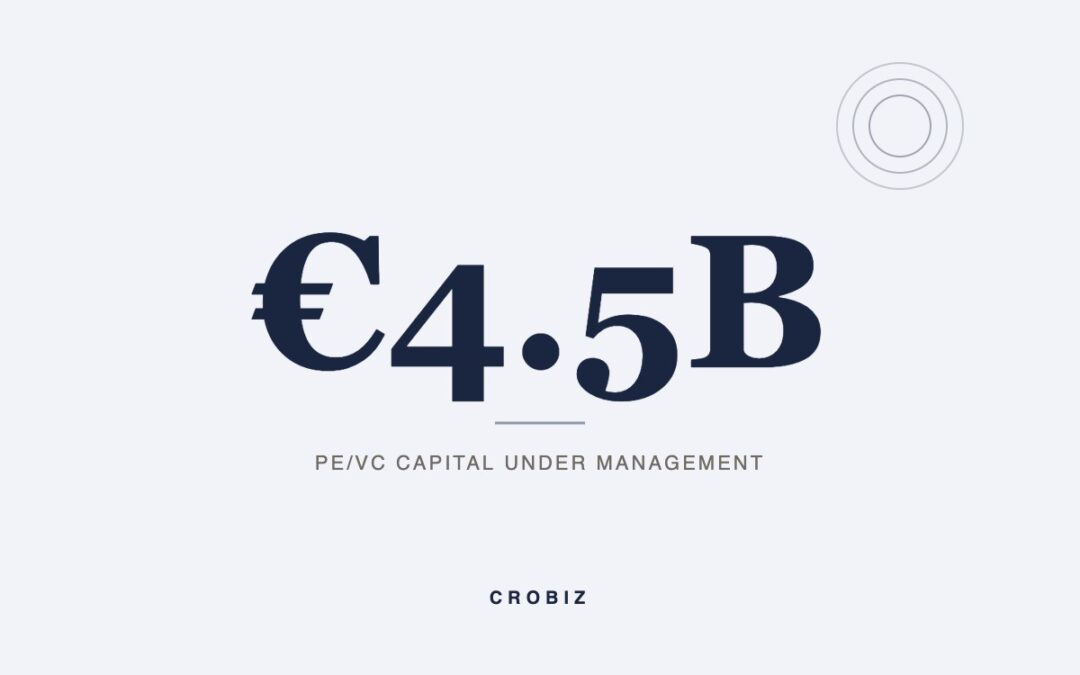
The Croatian Private Equity and Venture Capital Association (CVCA) brings together 24 active funds with more than €4.5 billion under management. In 2021 and 2022, Croatian companies attracted over €1 billion a year in PE and VC investment.
- Domestic VC funds: Fil Rouge Capital, AYMO Ventures, Silicon Gardens, Feelsgood Capital, Vesna VC, Inspire Investments, Provectus Capital Partners.
- Regional private equity: BlackPeak Capital, Blue Sea Capital, Enterprise Investors, Mid Europa, Integral Venture Partners, Morphosis Capital.
- Global success stories: Croatia has one of the highest numbers of unicorns per capita in the region, Rimac and Infobip, plus a growing group of soonicorns.
Source: CVCA
The bottom line
Croatia may be a frontier market on paper, but in practice it is a quiet and increasingly deep market where money is already flowing. The key is knowing where to look. CroBiz supports investors in Croatian companies and funds with due diligence, structuring and EU funding for growth.
This analysis was first published in the CroBiz newsletter for Polish investors. Want market signals like these in your inbox? Subscribe on our homepage or book a call to discuss your project.